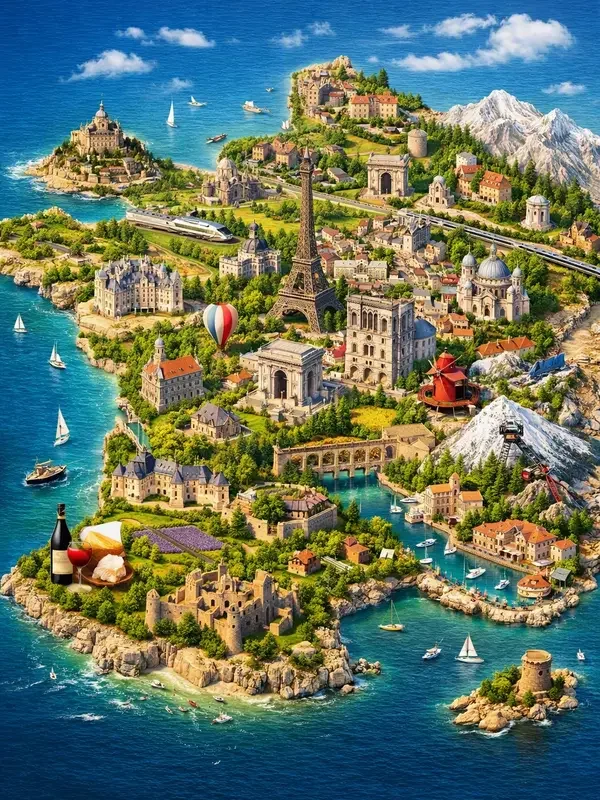
For travelers searching for France tourist attractions, the choices are almost endless. Paris remains the country’s best-known destination, but some of France’s most memorable experiences lie outside the capital. The official tourism website highlights attractions ranging from the Eiffel Tower and Opéra Garnier to Mont-Saint-Michel, the Pont du Gard, Château de Chambord, Château de Chenonceau, and the Arc de Triomphe. The country also offers extensive opportunities for outdoor travel. France currently has thousands of kilometers of cycling routes, national and regional nature parks, long-distance hiking trails, and diverse coastal landscapes. Whether you are interested in French landmarks, history, food, nature, art, or simply enjoying the atmosphere of a historic European city, France has something to match your travel style.
Discover France Through Its Geography
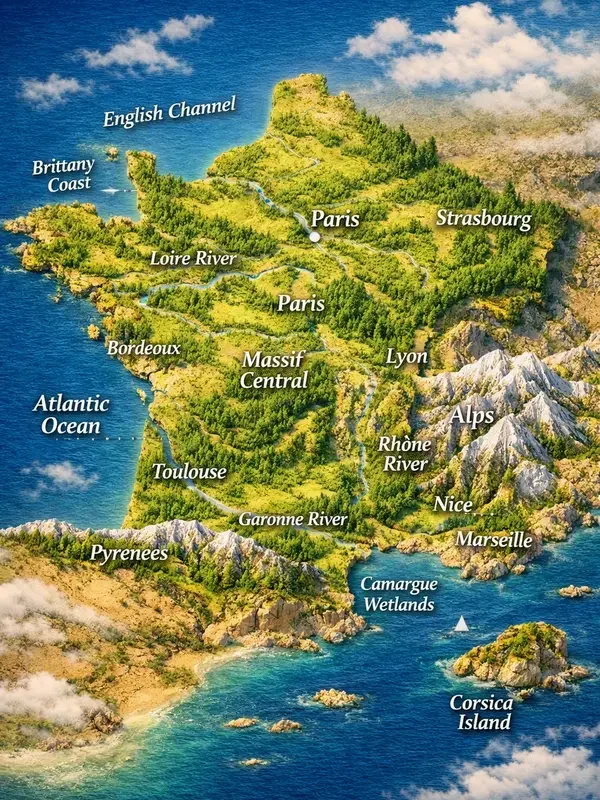
France’s geography is remarkably diverse. The country stretches from the Atlantic Ocean and English Channel to the Mediterranean Sea, while mountain ranges such as the Alps and Pyrenees create spectacular natural scenery. Vineyards, forests, beaches, rivers, countryside, and historic cities give every region its own character. Current official statistics estimate France’s population at about 69.1 million people in 2026, including metropolitan France and its overseas departments.
This geographical diversity is one reason France sightseeing can feel completely different from one region to another. Visitors can ski beneath the Alps, walk through lavender landscapes in Provence, explore Atlantic beaches, or enjoy the distinctive architecture of Alsace. France’s official tourism portal currently highlights dozens of destinations and cities, including Paris, Lyon, Bordeaux, Nice, Marseille, Strasbourg, and Toulouse.
A Journey Through the History of France
The History of France has been shaped by ancient civilizations, medieval kingdoms, royal dynasties, revolutions, wars, artistic movements, and political change. Travelers can experience this history not only in museums but also in streets, castles, churches, fortresses, and entire historic neighborhoods. From Roman remains in southern France to medieval towns and Renaissance châteaux, the country offers countless France historical places to explore.
Paris is an essential starting point. The Eiffel Tower, Arc de Triomphe, Notre-Dame, Sainte-Chapelle, and the historic banks of the Seine reveal different chapters of French history and architecture. Beyond the capital, places such as Mont-Saint-Michel, Versailles, Carcassonne, the Loire Valley châteaux, and Reims provide a much broader view of the country’s heritage. France’s official tourism authority describes its heritage as a combination of castles, cathedrals, Roman remains, museums, villages, and historic urban centers.
France Culture and the French Way of Life
France culture is closely connected with art, gastronomy, literature, fashion, architecture, music, and regional traditions. Food is an especially important part of everyday life, with each region offering its own specialties, ingredients, wines, and culinary traditions. From Parisian cafés to Provençal markets and Bordeaux’s wine culture, eating and traveling often become part of the same experience.
French culture is also highly regional. Brittany has its Celtic influences and coastal traditions, Alsace reflects a distinctive blend of French and Germanic heritage, Provence is known for Mediterranean landscapes and traditions, while the French Riviera combines historic towns with glamorous coastal resorts. These regional differences make Travel to France more than a visit to a single destination; it can become a journey through many different cultures within one country.