Champs-Élysées: History, Attractions, Access, and Everything You Need to Know
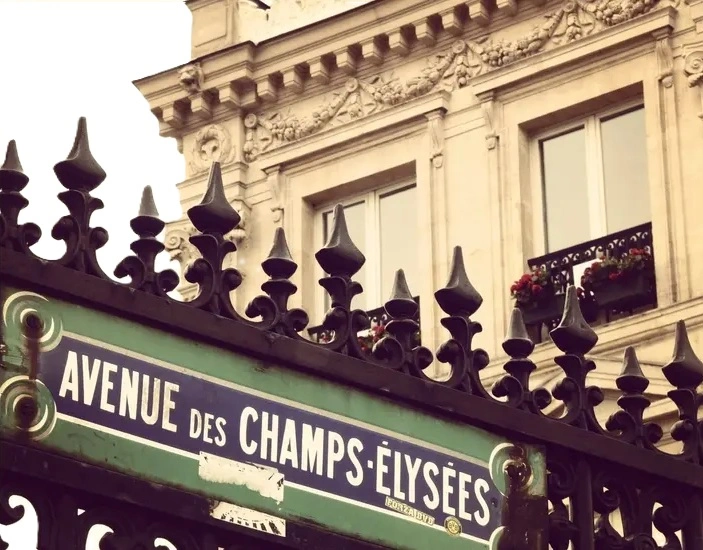
If one Parisian street captures the imagination of visitors before they even arrive in France, it is the Champs-Élysées. Officially the Avenue des Champs-Élysées, this legendary boulevard runs for roughly 1.9 kilometers through the 8th arrondissement, linking Place de la Concorde with Place Charles de Gaulle and the Arc de Triomphe. It is far more than a shopping street. It is a stage for French history, national celebrations, tourism, luxury fashion, sport, architecture, dining, and everyday Parisian life. Paris tourism authorities estimate that it receives close to 300,000 visitors per day.
What makes the avenue fascinating is that several versions of Paris meet in one place. At the western end, the Arc de Triomphe forms a cinematic backdrop; at the eastern end, gardens, Place de la Concorde, and the Tuileries open toward the historic heart of the capital. In between lie luxury boutiques, global brands, cinemas, cafés, museums, and some of the city’s most recognizable views. This article covers the history of the Champs-Élysées, its main attractions, and the easiest ways to reach and explore it.
What Is the Champs-Élysées and Why Is It Famous?
The Champs-Élysées is one of the most recognizable avenues in Paris and a central element of the city’s monumental western axis. Running from Place de la Concorde to the Arc de Triomphe, its broad layout, tree-lined sidewalks, grand perspective, and prestigious buildings have made it a symbol of Paris for generations.
It is famous partly because it does not represent just one side of the city. History enthusiasts can explore the Arc de Triomphe; fashion lovers can spend hours among French and international brands; art lovers can combine a stroll with the Grand Palais and Petit Palais; and anyone seeking atmosphere can sit on a café terrace and watch Paris go by. The avenue is also deeply tied to national life, including the July 14 military parade, sporting celebrations, and public festivities. This gives it an unusual personality: it is at once a historic monument, commercial district, tourist destination, public gathering place, and working city street.
Location and Character
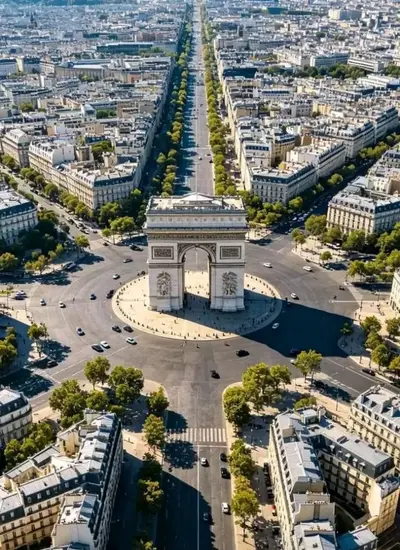
The avenue lies in the 8th arrondissement, one of Paris’s most prestigious districts. Its eastern section is surrounded by gardens and monumental architecture, while the western section grows busier and more commercial toward the Arc de Triomphe. At about 70 meters wide, it has a grand scale quite different from the narrow streets of older Paris.
It is best understood as part of Paris’s historic axis, an immense urban perspective running west from the Louvre through the Tuileries, Place de la Concorde, the Champs-Élysées, and the Arc de Triomphe toward La Défense. Walking the avenue lets you experience this centuries-old composition physically, connecting royal planning, imperial ambition, republican symbolism, and modern Paris.
The Meaning of the Name
The name comes from Greek mythology: the Elysian Fields, or Elysium, were a blessed afterlife reserved for heroes and the virtuous. The poetic reference suited an area of gardens, greenery, and leisure on the edge of the dense city. According to the City of Paris, André Le Nôtre created the avenue in 1674 as an extension of the Tuileries Garden, and the name Champs-Élysées was officially applied in 1698 to the lower section before coming to describe the whole avenue after the Revolution.
The mythological name suggests an idealized landscape rather than commerce and traffic, and the contrast with the avenue’s modern commercial identity is part of its charm. Today the name can mean luxury shopping, the Arc de Triomphe, French history, or simply the quintessential Paris experience.
The History of the Champs-Élysées
In the 17th century, the area west of the Tuileries was open and largely undeveloped. Under Louis XIV, the landscape architect André Le Nôtre, famous for Versailles, extended the Tuileries’ landscaped structure westward, laying the foundation for the monumental perspective that defines the avenue. In 1710 the route was extended farther west toward the site where the Arc de Triomphe would later stand.
The avenue did not become today’s boulevard overnight. During the 18th and early 19th centuries it evolved from a landscaped promenade into a more structured avenue, and the 19th-century modernization of Paris completed the process. That long evolution is why walking it feels like moving through layers of French history: royal planning, revolutionary change, imperial symbolism, and modern commerce all visible within a short distance.
From Royal Gardens to Grand Avenue
The original idea was tied to landscape design and royal urban planning. Rather than a shopping destination, it was an extension of the gardens of the Tuileries palace. The straight line westward created a spectacular perspective and encouraged the city to grow beyond its traditional boundaries, in keeping with an approach that used broad avenues to express power, order, and beauty.
By the 19th century the surroundings had urbanized, and the avenue became the mix of promenade and prestigious thoroughfare we recognize today. Baron Haussmann’s transformation of Paris reinforced the importance of broad streets and monumental views. The avenue became a natural setting for ceremonies, parades, fashionable society, and commerce, while the gardens remained a key feature of the eastern section.
The 19th Century
The 19th century was decisive. Buildings, businesses, entertainment venues, and public spaces increasingly shaped the avenue, and the Arc de Triomphe added a monumental focal point at the western end.
Napoleon I commissioned the Arc after the Battle of Austerlitz. Construction began in 1806 under architect Jean-François-Thérèse Chalgrin and finished in the 1830s, with an inauguration in 1836; the Tomb of the Unknown Soldier was added beneath it in 1920. The avenue gives the monument its grand approach, and the monument gives the avenue an unmistakable destination. Together they form one of Europe’s most recognizable urban compositions.
The Champs-Élysées in Modern French History
Few streets anywhere have served so often as a stage for national history. Its width, central location, and symbolic status make it a natural setting for mass gatherings. Through the 20th and 21st centuries it has hosted military ceremonies, liberation celebrations, political rallies, sporting festivities, and cultural events. One of the most powerful moments came in 1944, when General Charles de Gaulle took part in the liberation parade along the avenue after the liberation of Paris.
The connection continues today. The avenue is linked with the July 14 military parade, and when France won the FIFA World Cup in 1998 and 2018, enormous crowds poured onto it. It functions almost like France’s giant public living room, where ordinary commerce can suddenly give way to collective celebration watched worldwide.
Celebrations, Parades, and National Events
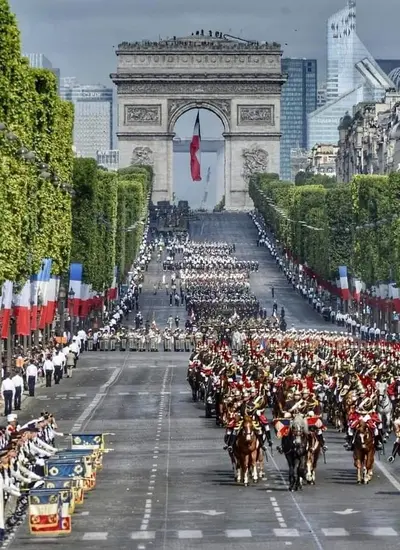
The July 14 Bastille Day parade is the best-known recurring event. Military personnel traditionally march between the Arc de Triomphe and Place de la Concorde in a ceremony combining tradition, national symbolism, and spectacle. Paris tourism information dates the tradition to 1880 and says it draws hundreds of thousands of spectators.
Such events change the practical experience of visiting: road closures, crowd control, access restrictions, and altered public transport are common. Travelers visiting on a national holiday should check current arrangements, because the avenue remains an active public space whose normal rhythm can change dramatically.
Sporting Events
Sport is another part of the avenue’s modern identity. It is internationally famous as the traditional finish of the Tour de France, when riders enter a monumental setting surrounded by huge crowds. It has also hosted other sporting and Olympic-related celebrations.
The 2024 Paris Olympic and Paralympic period gave it another international moment: Paris tourism authorities report that the avenue hosted celebrations including the Paralympic opening ceremony and a champions’ parade. Its real strength is its ability to turn major cultural and sporting moments into shared public experiences.
The Arc de Triomphe
The Arc de Triomphe is arguably the avenue’s most important attraction. Standing at the western end and dominating Place Charles de Gaulle, it was commissioned by Napoleon to celebrate the French army. Construction began in 1806, and Napoleon did not live to see its completion. The City of Paris describes it as roughly 50 meters high, with an inauguration in 1836.
The monument matters for its sculptures, inscriptions, and historical memory, which reflect France’s revolutionary and Napoleonic military history. Beneath it lies the Tomb of the Unknown Soldier, installed in 1920 to commemorate an unidentified French soldier of the First World War, with an eternal flame adding a layer of national remembrance. A visit moves you from contemporary consumer culture into the symbolic heart of modern France.
History and Architecture
The Arc was designed to convey power. Its scale is especially impressive when approached from the avenue, which provides a long, straight visual corridor, and its position above the surrounding traffic circle makes it seem even more imposing. It belongs to the tradition of triumphal arches inherited from ancient Rome, which commemorated victories and important figures.
One practical point: the Arc stands in the middle of a major traffic circle, so never try to cross the roadway directly. Pedestrian passages lead beneath the traffic. Once inside, visitors can explore the monument and, when available, climb to the viewing level.
The View From the Top
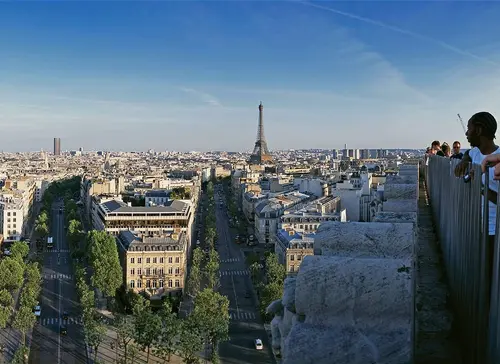
For many visitors the highlight is the panorama. From above, the geometry of Paris becomes clear: the Champs-Élysées stretches toward Place de la Concorde while other major avenues radiate from the square. Looking east, you can see the monumental axis crossing central Paris.
The view also explains why the location was so carefully chosen. From street level the avenue can feel like a busy shopping district, but from above it is plainly one line in a much larger geometric network. If you have time for only one paid attraction here, the Arc de Triomphe is a strong choice, combining architecture, history, and a panoramic view.
Grand Palais and Petit Palais
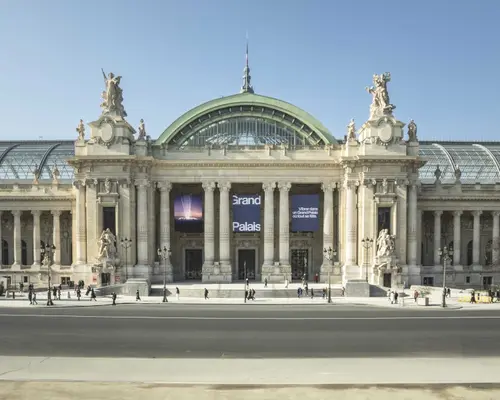
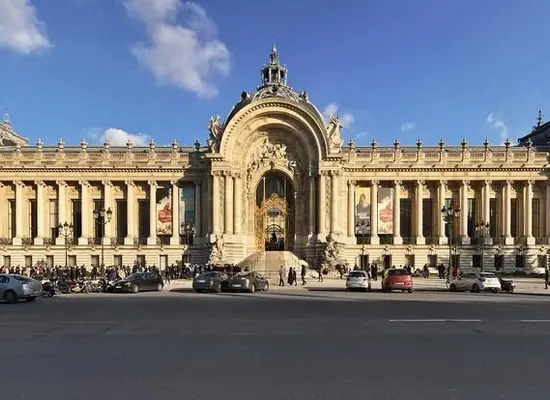
The lower section of the avenue is anchored by two cultural landmarks, the Grand Palais and the Petit Palais, both built for the 1900 Paris Exposition. Their monumental architecture gives the eastern part of the avenue a very different feel from the commercial west, with exhibition spaces, museums, and gardens rather than luxury stores.
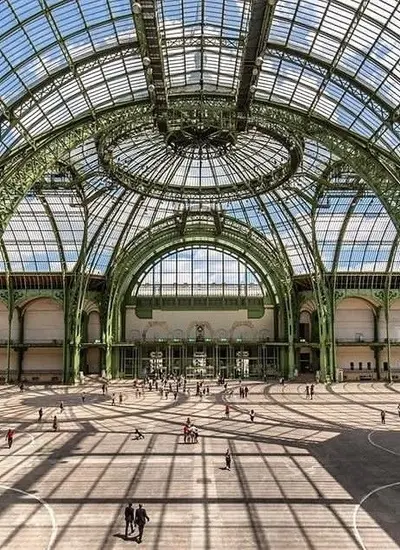
The Grand Palais is famed for its enormous glass roof and steel-and-stone construction and remains a major exhibition and event venue. The Petit Palais, opposite, houses the City of Paris Museum of Fine Arts, with collections spanning many periods.
A good approach is to start near Place de la Concorde, explore the gardens and palaces, then walk west toward the Champs-Élysées roundabout. This offers a gradual transition from historic Paris to the commercial avenue, and even visitors uninterested in museums can enjoy the architecture from outside.
Gardens and the Historic Axis
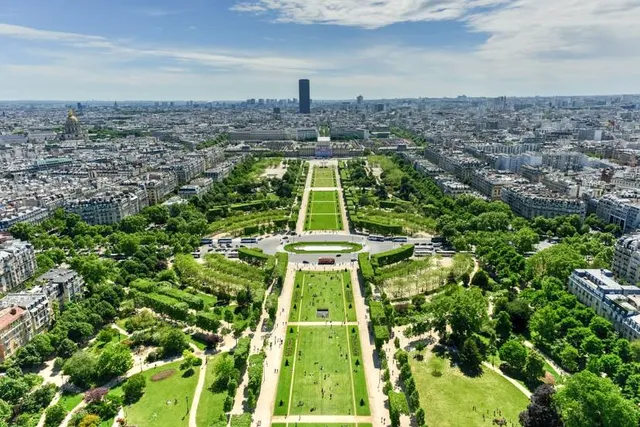
The Champs-Élysées Gardens cover much of the eastern section, roughly 13.7 hectares between Place de la Concorde and the roundabout, according to Paris tourism information. Lawns, mature trees, and paths make this stretch feel more like an urban park than a commercial street.
They preserve the avenue’s original relationship with landscape design. Before it became associated with luxury shopping, cinemas, and big events, the area was essentially a landscaped promenade. Walking the full length therefore means passing from a greener, open promenade near Place de la Concorde to a busier boulevard near the Arc, a gradual transition that makes the walk more interesting than hopping between metro stations.
The gardens are also part of the larger historic axis from the Louvre toward La Défense. Standing near Place de la Concorde and looking toward the Arc, you see a carefully developed composition, which is one reason the avenue remains so visually powerful.
Shopping
Shopping is the most recognizable modern activity here, especially in the western half. Visitors find French luxury houses, international fashion companies, beauty brands, sports stores, and large flagships. Paris tourism authorities list brands including Louis Vuitton, Guerlain, Cartier, Tiffany & Co., Lacoste, Longchamp, Zara, Sephora, and Nike.
The experience is not about bargains but about Parisian retail culture and global flagship design. Some stores are destinations in themselves, with elaborate interiors, exhibitions, and displays, so simply walking through can be an attraction for fans of fashion or retail architecture.
The avenue can be expensive, so separate sightseeing from shopping when budgeting. Window-shopping, photography, people-watching, and nearby museums cost far less than an afternoon in designer boutiques. If shopping is your goal, research individual stores first, since hours and closures change.
Restaurants, Cafés, and French Food
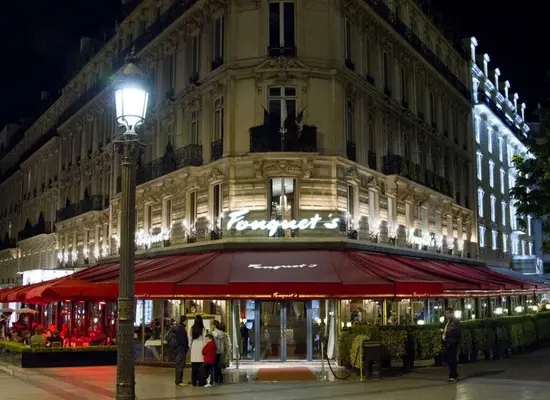
The avenue and surrounding streets offer restaurants, cafés, brasseries, bakeries, dessert shops, and international dining. Historic establishments such as Fouquet’s add to its glamorous reputation, while Ladurée is internationally associated with French pastries and macarons.
Dining here is often about atmosphere as much as cuisine. A café terrace lets you watch the avenue’s rhythm during a break from sightseeing, but prices in such a prominent tourist location run higher than in less central neighborhoods. For authentic everyday French food at lower cost, walk a few streets away.
A useful strategy is to treat food as part of the route: begin near Place de la Concorde, stroll through the gardens, stop for coffee or a pastry, continue toward the Arc, and have a longer meal in the surrounding 8th arrondissement.
Nightlife and Entertainment
After dark the avenue changes character. Lighting, illuminated storefronts, restaurants, cinemas, and late-opening businesses create an atmosphere quite different from daytime. Cinemas and theaters have long made it an evening destination, and restaurants and bars attract visitors and locals alike.
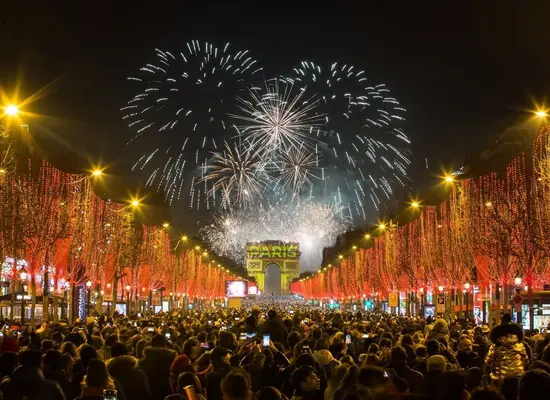
The Arc de Triomphe and the long perspective toward Place de la Concorde are especially photogenic at night. Paris tourism authorities highlight Christmas lights and New Year’s celebrations among its seasonal attractions.
Use normal urban precautions in crowded tourist areas: keep valuables secure, stay aware of your surroundings, and use official transport. The central location makes it easy to continue the evening elsewhere in the city.
Getting There by Metro and RER
Public transport is generally the easiest way to reach the avenue. Metro Line 1 runs directly along it, with stations at Champs-Élysées–Clemenceau (near the Grand Palais and Petit Palais), Franklin D. Roosevelt (near the central roundabout), George V (in the commercial section), and Charles de Gaulle–Étoile (near the Arc de Triomphe). Lines 9 and 13 offer useful connections to different sections. RER A also serves Charles de Gaulle–Étoile, convenient for those arriving from the wider Paris region.
Choose your station by goal: Charles de Gaulle–Étoile for the Arc, George V for luxury shopping, and Champs-Élysées–Clemenceau for the Grand Palais and Petit Palais. Since the avenue is nearly two kilometers long, the right station saves walking time, though if you have time, starting at one end and walking the whole avenue is arguably the best option.
Getting There by Bus, Bicycle, and Car
Several bus routes serve the avenue and nearby streets, including 22, 28, 32, 42, 52, 73, 80, and 93 in the broader area. Buses let you see the city above ground, though traffic makes journey times less predictable.
Cycling is increasingly practical, with cycling infrastructure and Vélib’ stations nearby, but walking remains the most rewarding method for first-timers because the avenue’s scale is hard to appreciate from a vehicle.
Driving is possible but rarely convenient: traffic around the Arc can be intense, parking is limited and expensive, and events may bring restrictions. Paris tourism authorities recommend public transport, especially in busy periods.
Walking Route
Walking is arguably the best way to experience the avenue. The full route between Place de la Concorde and the Arc is about 1.9 kilometers, roughly 30 minutes without stops, though most visitors should allow much longer for photographs, shops, gardens, cafés, and museums.
A good route starts at Place de la Concorde and enters the Champs-Élysées Gardens, heading west past the Petit Palais and Grand Palais toward the central roundabout. From there the avenue turns more commercial, with major brands appearing more often. Continue toward George V and the Arc de Triomphe, finishing with the monument and its view over Paris.
Walking in the opposite direction also works, and starting at the Arc gives a dramatic perspective toward Place de la Concorde. Either way, don’t rush: the avenue is less a box to check than a famous urban landscape to experience.
Best Time to Visit
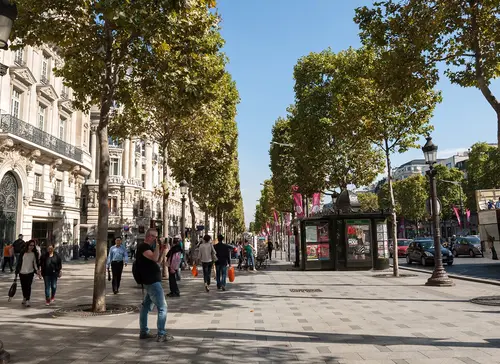
There is no single perfect time. Mornings are best for a peaceful walk, since the avenue grows busier as the day goes on. Late afternoon suits those combining sightseeing, shopping, and evening atmosphere, and after dark the illuminated avenue and Arc offer an entirely different view.
Spring and early autumn offer comfortable walking weather, summer brings long daylight and a lively mood, and winter, though colder, features seasonal lights and decorations. On the first Sunday of each month, the Champs-Élysées Pedestrian Initiative closes the avenue to traffic for a period (hours vary by season), letting visitors enjoy it with far fewer vehicles.
For photography, aim for sunrise or near sunset, when traffic is lighter and the light softer. For shopping, daytime is more practical. For atmosphere, begin in late afternoon and continue into the evening.
Events and Seasonal Attractions
The event calendar keeps the avenue dynamic. The July 14 parade is the most famous, the Tour de France finish makes it iconic in cycling, and New Year’s celebrations and Christmas illuminations add seasonal interest. Its role in the 2024 Paris Olympic and Paralympic celebrations showed again how well its scale and symbolic backdrop suit large public events.
Events can transform the visit, with barriers, security arrangements, stages, or temporary installations replacing normal traffic. This can be exciting, but check official information beforehand, as transport routes, station access, and some areas may be modified or closed.
Practical Tips
First, decide which section matters most. The eastern section near Place de la Concorde is stronger for gardens, architecture, and museums; the western section is better for shopping, restaurants, and the Arc de Triomphe. With only an hour or two, choose your starting point accordingly.
Second, wear comfortable shoes, because combining the avenue with the Grand Palais, Petit Palais, Place de la Concorde, the Tuileries, and the Arc can quickly become several hours of walking. Third, consider using the Metro in one direction and walking the other, for instance arriving at Charles de Gaulle–Étoile, visiting the Arc, and walking down toward Place de la Concorde.
Finally, remember that the Champs-Élysées is a real city street, not a museum with one entrance and closing time. Shops, restaurants, museums, and monuments keep their own schedules. Many shops open around 10 a.m. and stay open into the evening, but hours vary, so check specific places before traveling.
Is the Champs-Élysées Worth Visiting?
Yes, with realistic expectations. Some travelers expect an untouched historic street of elegant architecture and traditional cafés, but parts of the avenue are busy, commercial, crowded, and highly international. That does not diminish the experience; it shows another side of Paris, where history and global modern culture coexist.
Its greatest strength is the combination of experiences in a compact area: historic gardens, monumental architecture, major cultural institutions, famous stores, restaurants, public events, and the view from the Arc de Triomphe. Few streets offer such a concentrated mix of history and contemporary life.
It is also a gateway rather than an endpoint. From here you can continue to the Tuileries and Louvre, explore the 8th arrondissement, visit museums around the Grand Palais, or head west toward La Défense, making it a central thread of a wider Paris itinerary.
Conclusion
The Champs-Élysées is much more than a famous shopping avenue. Its story begins in the 17th century with royal landscape planning by André Le Nôtre, continues through the transformations of the 18th and 19th centuries, and reaches the present through national ceremonies, sport, tourism, luxury retail, culture, and public celebration. Its name, borrowed from the Elysian Fields, reflects its early association with gardens and leisure, while its modern identity reflects centuries of urban change.
For travelers, the appeal lies in variety: the Arc de Triomphe for history and views, the Grand Palais and Petit Palais for art and architecture, the gardens for greenery, and the shops, restaurants, and entertainment for modern atmosphere. Its link to the wider historic axis makes it most valuable as part of a walking itinerary.
Access is straightforward, with Metro Line 1, Lines 9 and 13, RER A, buses, cycling routes, and pedestrian paths. Whether you come on a quiet morning, a busy afternoon, an evening under the lights, or during a national celebration, the avenue brings together Paris’s past and present on one extraordinary urban stage.
Frequently Asked Questions
1. What is the Champs-Élysées famous for?
Its monumental architecture, luxury and high-street shopping, restaurants, gardens, cultural institutions, and major public events. It connects Place de la Concorde with the Arc de Triomphe, forms part of Paris’s historic axis, and is strongly associated with the July 14 parade, the Tour de France finish, and New Year’s events.
2. How long is the Champs-Élysées?
About 1.9 kilometers, between Place de la Concorde and Place Charles de Gaulle. A straightforward walk takes around 30 minutes, though most visitors spend much longer.
3. What is the best metro station?
It depends on your goal. Charles de Gaulle–Étoile suits the Arc de Triomphe, George V the central shopping area, Franklin D. Roosevelt the roundabout area, and Champs-Élysées–Clemenceau the Grand Palais, Petit Palais, and eastern end. Line 1 is the most useful for exploring several sections.
4. Can you visit for free?
Yes. Walking the avenue, viewing the gardens, and enjoying the architecture and atmosphere cost nothing. The Arc de Triomphe, museums, exhibitions, cinemas, and restaurants require separate payment.
5. How much time should you spend there?
About an hour for a quick walk, and two to four hours for a more comfortable visit including the Arc, gardens, shops, photos, and a meal or coffee. With the Grand Palais, Petit Palais, or other nearby sights, allow half a day or more.